
How to Install Bathroom Cabinets From Floor to Ceiling in 10 Steps
To install bathroom cabinets from floor to ceiling in 10 steps, you'll need to clear the space, assess your storage needs, and gather necessary tools. Measure the wall space, identifying obstructions like plumbing fixtures and electrical outlets. Choose cabinets that fit your unique bathroom dimensions, plan the layout, and assemble the frames. Install floor cabinets, ensuring alignment with the wall and floor, then add wall and ceiling cabinets. Next, add shelves and accessories, and conduct a final inspection to address any mistakes or imperfections. By following these steps, you'll be well on your way to creating a functional and stylish bathroom storage solution that meets your needs.
Key Takeaways
- Clear the bathroom space of clutter, fixtures, and obstructions before starting the installation process.
- Assess storage needs and determine required cabinet features, such as drawers, shelves, or combinations, to ensure a functional design.
- Measure the wall space accurately, considering plumbing and electrical work, to ensure a seamless fit for the cabinets.
- Assemble cabinet frames according to the manufacturer's instructions, ensuring squareness and secure shelves and components.
- Install floor, wall, and ceiling cabinets, ensuring level and plumb alignment, and add shelves and accessories to maximize storage and functionality.
Prepare the Bathroom Space
Before commencing the installation of bathroom cabinets, clear the bathroom space of any clutter, fixtures, or obstructions that may hinder your progress. This includes removing any existing cabinets, shelves, or storage solutions that you won't be using.
You'll be amazed at how much more you can accomplish when you're not tripping over yesterday's hair dryer or last week's towels.
Next, cover the floor and any remaining fixtures with drop cloths or plastic sheets to protect them from dust and debris. This will save you the headache of cleaning up messes later on.
Now's also a great time to take inventory of your bathroom organization needs. Think about what storage solutions you'll need to keep your bathroom essentials within easy reach.
Will you need cabinets with drawers, shelves, or a combination of both? Make a list of your must-haves to guarantee your new cabinets meet your needs.
Measure the Ceiling Height
With your bathroom space prepared, you're ready to focus on the specifics of your cabinet installation. Measuring the ceiling height is an essential step to guarantee your cabinets fit perfectly and make the most of your bathroom's vertical space. Don't assume you know the ceiling height - measure it! Grab your trusty tape measure and record the distance from the floor to the ceiling.
Consider the type of ceiling materials you're working with, as this may affect your height adjustments. For example, if you have a drop ceiling, you'll need to factor in the space between the drop ceiling and the main ceiling.
Here is a handy reference table to help you plan:
| Ceiling Type | Height Adjustment | Notes |
|---|---|---|
| Standard Drywall | 0" | Typical ceiling type |
| Drop Ceiling | -2" to -6" | Depends on drop ceiling design |
| Vaulted Ceiling | +2" to +6" | Depends on vaulted ceiling design |
| Popcorn Ceiling | 0" to -1" | Textured ceiling may require adjustments |
| Coffered Ceiling | -1" to -2" | Ornate ceiling design may require adjustments |
Remember to account for any obstructions, such as vents or ductwork, when making your measurements. With accurate measurements, you'll be ready to move on to the next step: choosing the right cabinets for your bathroom.
Choose the Right Cabinets
You'll need to select cabinets that fit your bathroom's unique dimensions, so consider the range of cabinet size options available, from compact to large, and measure your bathroom space to determine the maximum size that will fit comfortably.
Additionally, think about the style you want to achieve, as cabinets come in various styles, such as modern, traditional, and contemporary, each with its own set of characteristics.
Cabinet Size Options
As you plan your bathroom renovation, selecting the right cabinet size is essential to guarantee a functional and aesthetically pleasing space.
You'll want to take into account cabinet dimensions that fit your bathroom's unique layout. Standard cabinet widths range from 12 to 60 inches, with depths typically falling between 12 and 24 inches. However, you may need to customize your cabinet size to accommodate plumbing fixtures, electrical outlets, or other obstacles.
When choosing your cabinet size, think about the items you'll be storing. If you've got a lot of bulky toiletries, you'll want deeper cabinets. If you're short on floor space, think about narrower cabinets.
Remember, you can always opt for adjustable shelves or dividers to maximize storage capacity. Don't forget to factor in the height of your ceiling, too - floor-to-ceiling cabinets can make a big impact, but may require special installation.
Measure Bathroom Space
To guarantee a seamless fit, measure your bathroom space carefully to choose the right cabinets. Take precise measurements of the floor, walls, and any obstructions like plumbing or electrical outlets. Record the dimensions, including the distance between the floor and ceiling, to determine the maximum height of your cabinets.
Consider the space around the sink, toilet, and shower or bathtub to make certain your cabinets won't interfere with daily use. When measuring, keep in mind the type of cabinet materials you'll be working with. For example, wood cabinets may require more clearance than MDF or laminate ones.
Make sure you have the necessary installation tools, like a level, tape measure, and stud finder, to guarantee accurate measurements. Don't forget to measure any windows or doors that may affect cabinet placement.
Cabinet Style Choices
Cabinet style choices are vast, ranging from modern and sleek to traditional and ornate, so selecting the right cabinets for your bathroom requires careful consideration.
You'll want to think about the overall aesthetic you're going for, as well as the functional needs of your space. Do you prefer modern designs with clean lines and minimal ornamentation, or traditional styles with intricate details and ornate carvings?
Consider your bathroom's color schemes and how the cabinets will fit in. Will you choose a bold, contrasting color or a more subtle, matching tone?
Material choices are also essential, as they can impact durability, maintenance, and overall look. You may opt for sturdy wood, sleek glass, or durable metal.
Don't forget to think about functional features, like adjustable shelves, soft-close drawers, or pull-out trash cans.
Decorative accents, such as crown molding or intricate hardware, can add a touch of personality to your space.
If you're working with a small bathroom, consider space-saving solutions like wall-mounted cabinets or corner units.
Plan the Cabinet Layout
Measure your bathroom space carefully to guarantee a seamless fit for your new cabinets. You don't want to end up with a cabinet that's an inch too wide or too tall, do you?
Take precise measurements of the floor, walls, and any obstructions like plumbing fixtures or electrical outlets. Don't forget to consider any windows, doors, or other features that might affect the cabinet design.
Next, think about space optimization. You want to maximize storage while maintaining a sense of openness in the bathroom.
Consider the "work zones" in your bathroom – areas around the sink, toilet, and shower – and plan your cabinet layout accordingly. For example, you might want to install a cabinet above the toilet for extra storage or a recessed cabinet near the sink for a sleek look.
Sketch out your cabinet design, factoring in the measurements and space optimization strategies. This will help you visualize the final product and make any necessary adjustments before you start installing.
Assemble the Cabinet Frames
You'll start assembling the cabinet frames by following the manufacturer's instructions for the frame assembly process, which typically involves attaching the sides, top, and bottom panels to the back panel.
Confirm accurate cabinet component alignment by checking the frame's squareness and making adjustments as needed.
Next, you'll secure the shelves and any additional components, such as drawers or doors, to the frame according to the manufacturer's specifications.
Frame Assembly Process
With your bathroom's layout freshly mapped out, the precision-cut frame components now await assembly. It's time to get your hands dirty and bring these pieces together.
Begin by gathering your frame materials, including the side panels, top and bottom panels, and shelves. Next, collect your trusty assembly tools, such as a drill, measuring tape, and clamps.
Start by assembling the side panels, using your drill to attach the hinges and handles. Make certain everything is square and level – you don't want your cabinets looking like they're about to topple over.
Once the side panels are secure, move on to the top and bottom panels. Use your clamps to hold them in place while you attach them to the side panels.
As you work, double-check your measurements to verify everything fits together seamlessly. Don't be afraid to tap in a few extra screws for good measure – after all, you want your cabinets to withstand the chaos of morning routines and impromptu dance parties.
With your frames taking shape, you're one step closer to a bathroom that's both beautiful and functional.
Cabinet Component Alignment
The frame components now require precise alignment to form a cohesive cabinet structure. Don't worry, it's not rocket science (although, if you're a rocket scientist, you're probably way ahead of us).
To achieve perfect cabinet alignment, start by identifying the reference points on each component. Typically, these are marked with small notches or dimples. Once you've located them, use a combination square to verify the frames are properly aligned. This is where patience and attention to detail come into play. Remember, a single misaligned component can throw off the entire cabinet.
For precision installation tips, use shims or small wedges to fine-tune the alignment. You can also use a laser level to project a straight line, confirming your cabinet frames are perfectly vertical.
When it comes to cabinet alignment techniques, it's all about taking your time and double-checking your work. Measure twice, hammer once – or, you know, just use a screwdriver and avoid the whole hammer situation altogether.
Install the Floor Cabinets
Three floor cabinets need to be installed in this bathroom renovation project. You'll need to verify they're perfectly aligned with the wall and floor to create a seamless look.
Start by identifying the floor cabinet materials, such as MDF, plywood, or solid wood, and their corresponding cabinet installation techniques. For example, MDF cabinets may require additional support due to their density, while solid wood cabinets can be installed using traditional woodworking methods.
Using your trusty tape measure, mark the floor where each cabinet will sit, considering any obstructions like plumbing or electrical outlets.
Next, prepare the cabinets by attaching the adjustable legs or feet, depending on the manufacturer's instructions. Place the cabinets in their marked positions, verifying they're level and plumb. Use shims if necessary to achieve the perfect fit.
Add the Wall Cabinets
Beyond the floor cabinets, your attention now turns to the wall cabinets, which won't only provide additional storage but also visually enhance the bathroom's design.
When choosing your wall cabinets, consider the materials that will best suit your bathroom's style and functionality. You can opt for stock cabinets made from MDF, plywood, or solid wood, or go for custom cabinets that fit your specific needs.
Before installation, confirm you have the necessary installation tools, including a level, drill, and screwdriver.
Begin by marking the wall studs with a pencil, taking care to avoid any plumbing or electrical fixtures. Hold the cabinet against the wall, using a level to verify it's straight, and mark the screw holes. Drill pilot holes and screw the cabinet into place, making sure it's secure and level.
Repeat this process for each wall cabinet, working from the top down to maintain stability. Don't forget to adjust the cabinet doors and drawers to guarantee smooth operation.
With your wall cabinets installed, you'll be one step closer to a beautifully organized bathroom.
Secure the Ceiling Cabinets
Ceiling cabinets provide the ultimate storage solution for infrequently used items, keeping them out of the way while maintaining easy access.
Now that you've got your wall cabinets in place, it's time to fasten those ceiling cabinets. Remember, stability is key here, so don't rush through this step.
Start by locating the ceiling studs using a stud finder. You'll want to anchor your cabinets to these studs for maximum support.
Hold the cabinet in place against the ceiling, confirming it's level and plumb. Use a laser level to double-check your work – you don't want any wonky cabinets up there.
Next, drill pilot holes into the ceiling and insert the screws or anchors provided with your cabinet. Make certain they're securely fastened to the ceiling support.
You may need to adjust the cabinet slightly as you go to verify everything is even and level.
With your ceiling cabinets securely in place, you can rest easy knowing your bathroom is one step closer to being organized and clutter-free.
Add Shelves and Accessories
You'll now focus on adding shelves and accessories to enhance the functionality and aesthetic appeal of your bathroom cabinets.
You have two shelf installation options: adjustable shelves that can be moved to accommodate different-sized items or fixed shelves that provide a more streamlined look.
As you plan accessory placement, consider the "zones" in your bathroom, such as a morning routine zone near the sink or a storage zone near the shower.
Shelf Installation Options
Several shelf installation options are available to enhance your bathroom cabinet's storage capacity and functionality.
You've got a blank canvas, and it's time to get creative! Consider the following options to maximize your cabinet's potential:
-
Floating shelves: Create a sleek, modern look by installing shelves that appear to be floating in mid-air. This style is perfect for showcasing decorative items or storing small essentials.
-
Adjustable shelving: Get flexible with shelves that can be adjusted to accommodate items of varying heights. This feature is especially useful for storing baskets, bins, or containers.
-
Corner shelves: Make the most of that often-wasted corner space with shelves specifically designed to fit snugly into the corner of your cabinet.
-
Decorative brackets: Add a touch of elegance with decorative brackets that support your shelves while adding visual interest.
-
Open shelving: Opt for open shelving to keep frequently used items within easy reach. This style also allows for creative display opportunities.
When selecting your shelf installation option, consider factors like shelf materials, height, and lighting to guarantee your cabinet meets your storage and organizational needs.
With these options, you'll be well on your way to creating a bathroom cabinet that's both functional and stylish.
Accessory Placement Ideas
Two key areas to focus on when adding shelves and accessories to your bathroom cabinet are the vertical and horizontal spaces. Maximize these areas to create a functional and stylish bathroom.
You can make use of the vertical space by installing decorative accents such as crown molding or LED lights to add visual appeal. For functional organizers, consider installing pull-out shelves, baskets, or carousels to keep essentials within easy reach.
In the horizontal space, add decorative accents like glass shelves or decorative trim to create a cohesive look. Functional organizers like drawers, cabinets, or open shelving units can be employed to store toiletries, towels, and other bathroom essentials.
Remember to balance form and function when selecting accessories. Verify that they not only look great but also serve a purpose.
Final Touches and Inspection
Your newly installed bathroom cabinets are almost ready for use, but before you can put them to the test, it's important to attend to the final touches and conduct a thorough inspection.
This is your last chance to catch any mistakes or imperfections before you start loading up your cabinets with toiletries and towels.
To guarantee a job well done, go through this inspection checklist:
- Check all cabinet doors and drawers for proper alignment and smooth operation.
- Inspect the cabinets for any scratches, dents, or other damage that may have occurred during installation.
- Verify that all hardware, including knobs and handles, is securely attached and functioning correctly.
- Test the cabinets' lighting, if applicable, to confirm it's working as expected.
- Take a step back and evaluate the overall aesthetic of the cabinets, making any necessary adjustments to achieve a polished look.
Frequently Asked Questions
Can I Install Bathroom Cabinets Without Professional Help?
You can tackle a DIY installation, but don't get caught up in the excitement - carefully consider your cabinet design skills and willingness to measure (a lot) before deciding to go solo.
How Do I Handle Uneven Ceiling Heights?
When dealing with uneven ceiling heights, you'll need to get creative with ceiling adjustments and leveling techniques. You'll want to measure, mark, and adjust your cabinets to fit snugly, ensuring a seamless look that'll make you say, 'Who needs a pro?'
What Is the Recommended Cabinet Material for Bathrooms?
Did you know 70% of bathroom remodels include new cabinets? You'll want to choose moisture-resistant materials, like medium-density fiberboard or PVC, which can withstand humidity. Consider sleek cabinet design styles, like Shaker or flat-panel, to create a stylish, functional space that'll make you feel like a pro!
Are Floor-To-Ceiling Cabinets Suitable for Small Bathrooms?
You're wondering if floor-to-ceiling cabinets are suitable for small bathrooms? Absolutely! They're a space optimization genius move, allowing you to maximize storage without sacrificing floor space, all thanks to clever cabinet design that'll make your tiny bathroom feel like a spa.
Can I Use Existing Cabinets and Just Add New Ones?
You're wondering if you can repurpose existing cabinets and add new ones, right? Well, it's doable if you guarantee cabinet compatibility, but it's essential to take into account design aesthetics, too, or you'll end up with a mismatched mess that's more eyesore than eye-candy.
Conclusion
You've reached the final stretch! After following these 10 careful steps, your floor-to-ceiling bathroom cabinets are now a stunning reality, changing your bathroom into a luxurious oasis that's the envy of a five-star hotel. Every detail is precision-perfect, every shelf aligned with military precision, and every accessory painstakingly placed. Stand back, admire your handiwork, and bask in the glory of your newly renovated bathroom – it's a work of art that will leave you breathless!
Related Posts
-
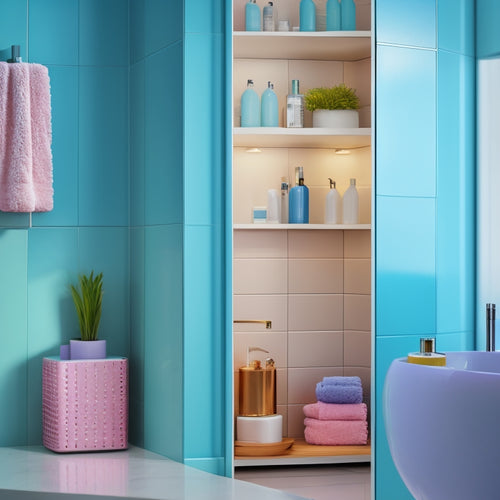
Top-Rated Compact Shower Caddies for Small Showers
When searching for top-rated compact shower caddies for small showers, focus on space-saving designs that maximize ve...
-
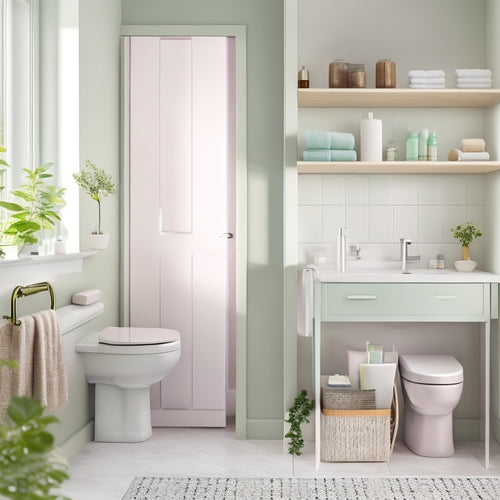
Wall-Mounted Bathroom Organizers for Small Spaces
Wall-mounted bathroom organizers are perfect for maximizing storage in small spaces. By utilizing vertical space, you...
-
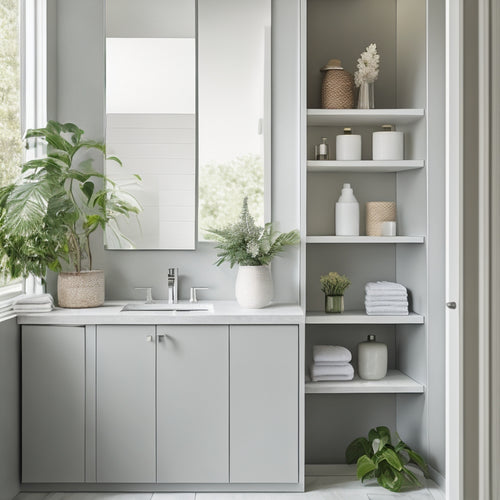
Modern Bathroom Cabinetry for Small Bathrooms
When designing modern bathroom cabinetry for small spaces, your focus should be on maximizing storage while embracing...
